
5, 6, 7, 8!
Integrating the Arts Into STEM Education

This photo essay was written by Sarah Thomas, a preschool educator working in New York City.
As part of our Clothing unit for Creative Curriculum, the students investigated how they could make tap shoes from loose parts. Prior to the investigations, the students studied dance (styles of dance, famous dancers, etc.) as the closing to our Music unit. The intention for this was to merge the two units of study to encourage students to build on prior understanding to help guide their learning. I wanted them to connect the two units to discover how clothing and scientific processes can relate to music and dance.
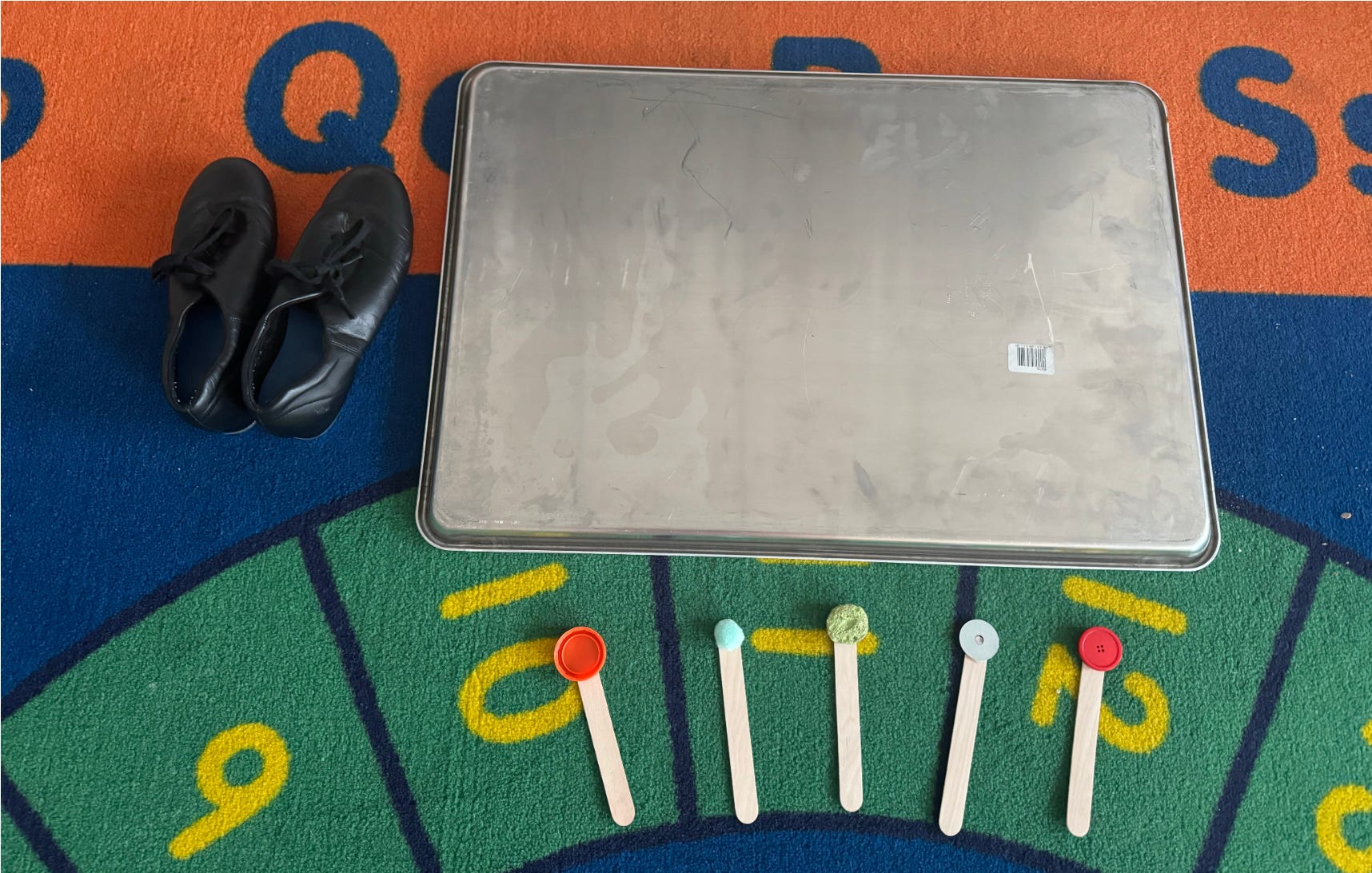
After watching videos of famous tap dancers, students were provided with various loose parts attached to popsicle sticks. A cookie sheet with along with a real pair of tap shoes were also presented. The students were invited to investigate sound with these materials.
The activity was intentionally set up this way to encourage open-ended investigation. I did not want to limit the thinking of my students or even explain the purpose of the experiment. I wanted the students to investigate sound and come to the conclusion of how it relates to tap dance and clothing.
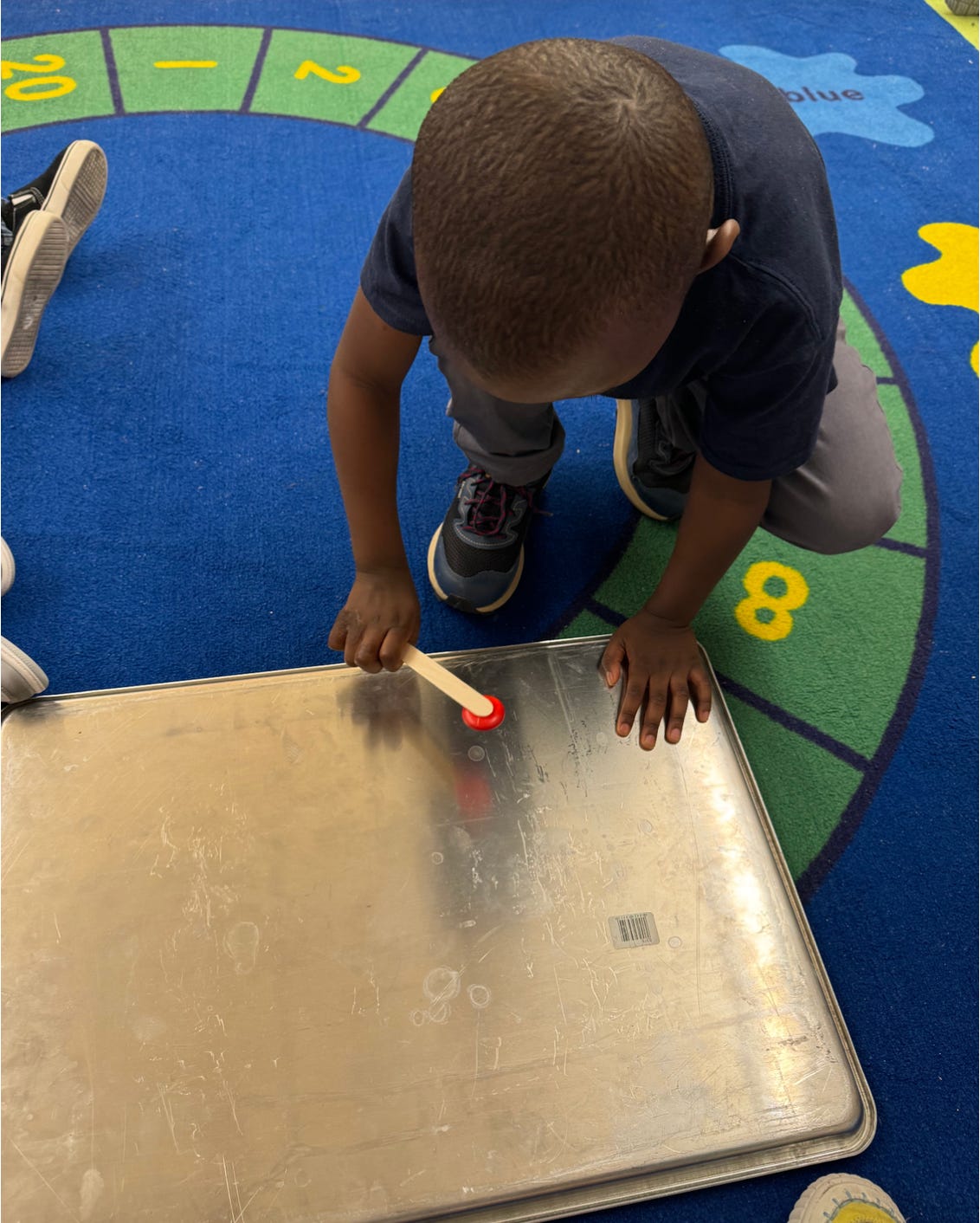
The students were able to quickly distinguish which items did not make much sound. They were able to conclude that the softer items (sponge, pom pom) did not interact with the surface enough to produce a noise. “Orange make sound. Wait, red one louder! Louder!” The students independently navigated their way through the harder objects (juice top, button, washer). They understood that each of them could produce a sound, but they were inquisitive enough to further research which would be the loudest.
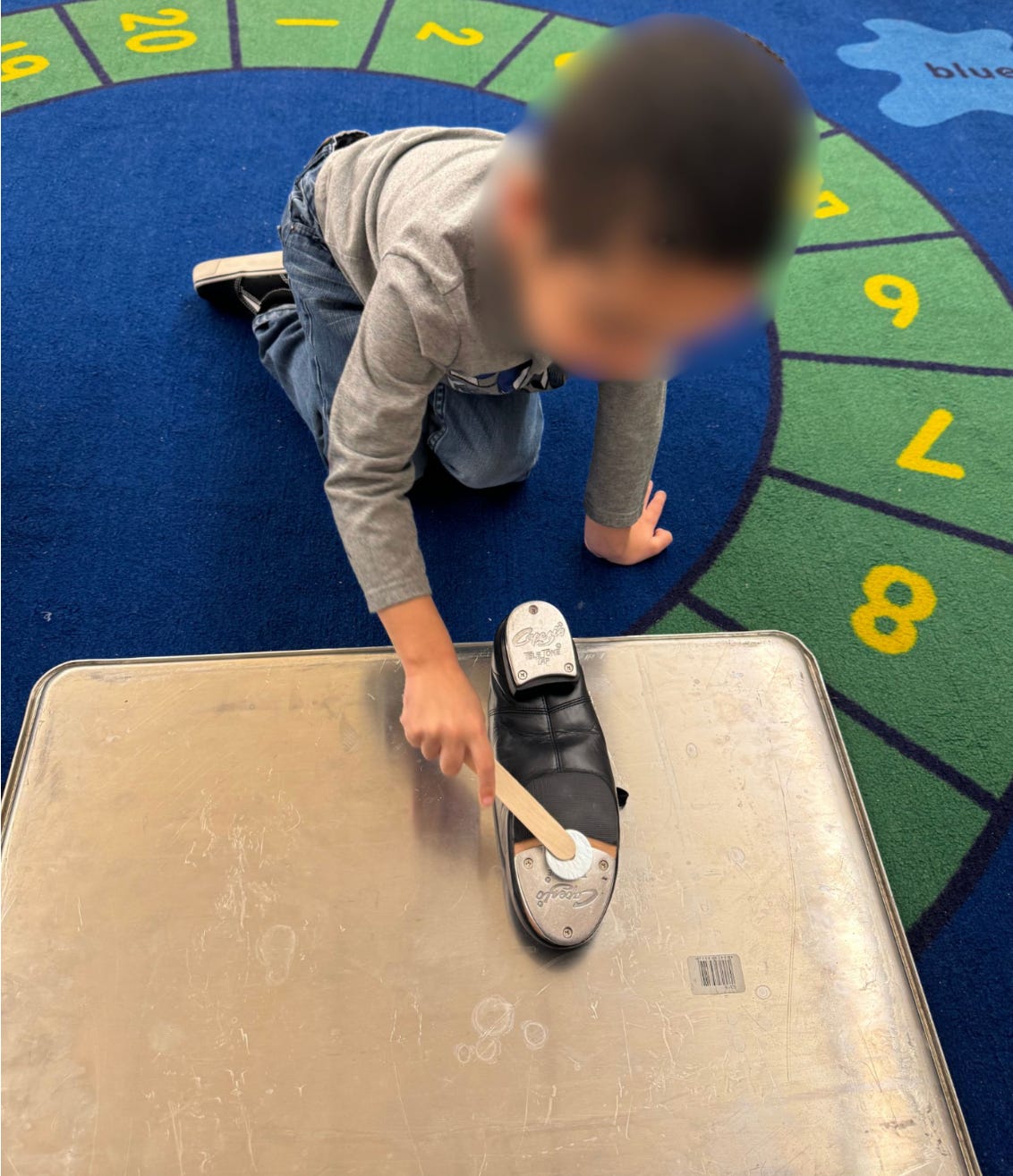
Although all of the heavier objects did produce a sound, our students concluded that the washer definitely had the loudest reaction with the cookie sheet. This student even went so far as to tap the shoe on the cookie sheet and then the washer after. He turned the tap shoe over and compared the loose part to the actual tap. Once he did this, I asked what we could do with this information. He responded, “Use the metal ones to make noise too!”
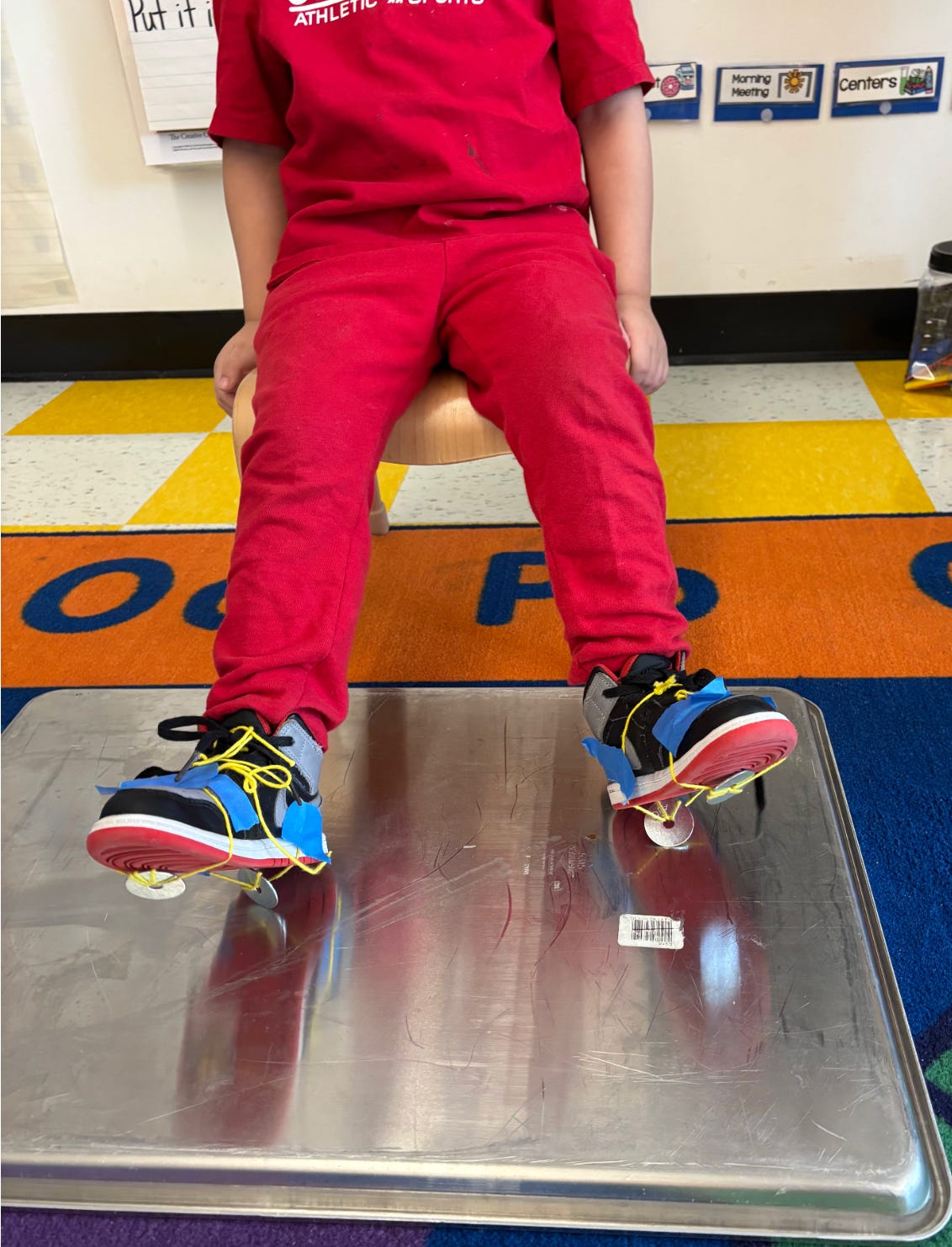
Collaboratively, we decided to try to make our own tap shoes using the washers. We first experimented with threading string through the washers and tying them around our shoes. As we tapped, the strings slid up and down. I asked the students how we could fix it. One responded, “Something sticky. Glue! Tape!” We then added tape to try to secure the strings. The washers then began to rotate and separate from our shoes. I then asked what this meant for our experiment. I asked if we should stop our investigation or continue. Some of the responses I received were:
“We can keep trying!”
“I want to dance for Mommy!”
“Tap tap dance, me! I do again!”
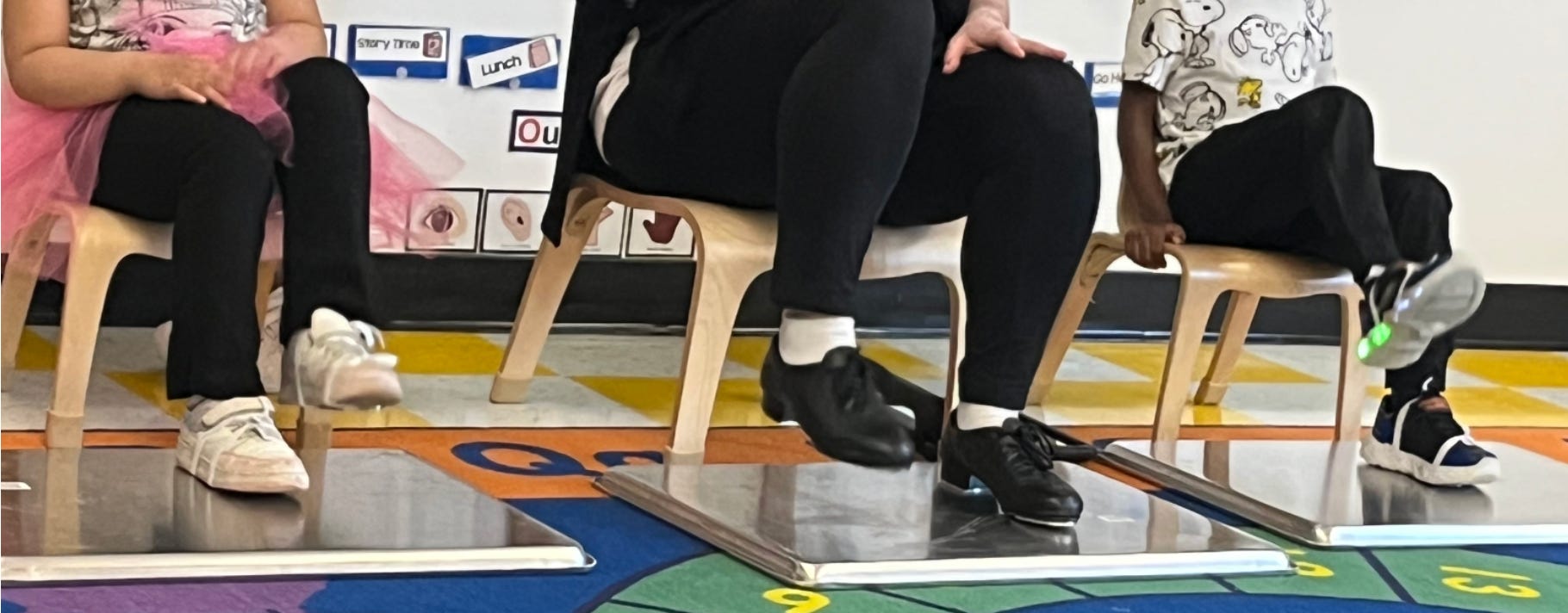
After a lot of trial and error in our experiment, the students were able to produce a prototype for their homemade tap shoes. Instead of string, we opted for elastic to easily slip on and off their shoes. Also, we were able to conclude that the elastic was a lot more durable than the string. Furthermore, we used glue to adhere the washers to the elastic to make them even more secure. We finished our study by performing a tap dance for our families with our successful shoes!
Sarah’s Reflection
This experiment brought a lot of valuable learning experiences for myself and my students. The students were so motivated by the activity. They wanted to learn to dance and make sounds themselves. This really guided their self-directed learning through motivation and questioning. Also, I learned how easy it can be to weave my own passions into teaching, specifically STEM curriculum. In the future, I hope to implement a permanent dance/STEM collaborative curriculum into my classroom.
EC STEM Lab’s Thoughts
We believe that powerful learning happens when children’s curiosity, creativity, and critical thinking are nurtured through meaningful, integrated experiences. Sarah’s project with her students exemplifies this approach beautifully. This project showcases how STEM concepts can be brought to life through the arts—in this case, music, dance, and engineering—while honoring children’s voices, questions, and problem-solving processes. It’s a joyful reminder that when we trust children as thinkers and makers, they rise to the challenge with imagination and determination.
Through this project, children investigated principles of sound and vibration (science), experimented with materials and their properties (engineering), and engaged in design thinking and iterative testing (engineering and technology) as they created their own functional tap shoes. The experience also naturally incorporated mathematical comparisons—louder vs. softer, heavier vs. lighter—as children observed cause-and-effect relationships. This arts-integrated investigation is a powerful example of how early STEM experiences can deepen children’s understanding of scientific concepts while nurturing their creativity, confidence, and collaborative spirit!
Thank you, Sarah, for sharing this inspiring example and for all of the incredible work you do for young children!
Feeling inspired by the Arts? We will talk about how to foster explorations like this one during our 2025 Preschool STEM Institute - Art Integrations Day!
Learn more here.
Love, love this.